

 Facebook
 X
X
 Pinterest
 Copy Link
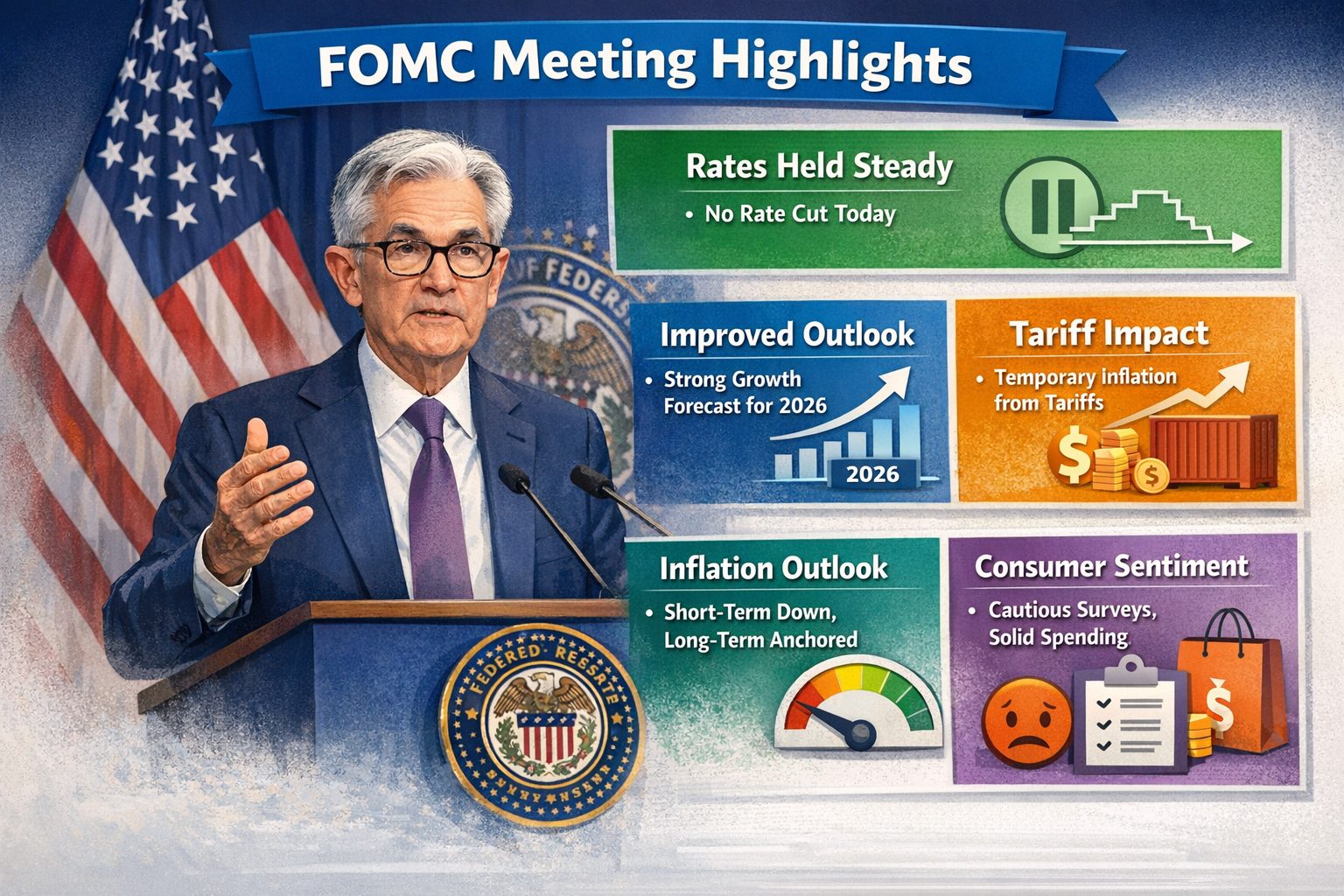
Fed Signals Stability Today — With a Looser Policy Path Emerging
The Federal Reserve held interest rates steady at today’s FOMC meeting. However, Chair Jerome Powell’s remarks offered meaningful insight into where policy may head next, especially for interest-rate-sensitive sectors like housing.
Growth Outlook Strengthens Into 2026
Powell stated that economic growth has started the year on solid footing. Moreover, the Fed’s outlook for 2026 has clearly improved, with stronger overall growth forecasts. Although rates were held steady, revised projections showed that a cut was actively considered, signaling growing confidence in economic momentum.
Tariffs and Inflation Dynamics Matter
According to Powell, recent inflation pressures are largely driven by tariffs. He described these impacts as a one-time pass-through to consumers, primarily affecting goods prices. Importantly, the Fed expects these effects to peak around mid-year and then begin to fade.
This distinction matters because tariff-driven inflation differs from demand-driven inflation. As Powell explained, demand-driven inflation is harder to control, while one-time pricing effects tend to unwind naturally.
Services Deflation Supports Future Rate Flexibility
Services inflation is already deflating meaningfully. If goods prices also begin to decline once tariff effects ease, the combined trend would justify looser monetary policy. Additionally, a weaker labor market would further support rate cuts.
For housing markets across King, Pierce, and Snohomish Counties, this suggests borrowing costs may remain stable in the near term while gradually improving later if inflation continues to cool.
Consumer Sentiment vs. Consumer Behavior
Powell also highlighted a disconnect between sentiment surveys and real-world behavior. While surveys show pessimism, actual consumer spending data remains reasonably strong. Therefore, the Fed continues to rely on hard data rather than sentiment alone.
What This Means for Local Real Estate
Taken together, today’s message points to stability now and potential easing ahead, but in the Puget Sound this plays out differently because housing supply remains structurally constrained. In King, Pierce, and Snohomish Counties, limited inventory driven by zoning, geography, and slow new construction means demand typically responds faster than supply when financing conditions improve. If inflation continues to normalize and mortgage rates ease even modestly, pent-up buyer demand is likely to reenter the market more quickly than new listings can materialize. As a result, a more supportive rate environment here is less likely to lead to price softness and more likely to stabilize or re-strengthen prices, particularly for well-located, move-in-ready homes, while competition increases without a meaningful expansion in inventory.


