

 Facebook
 X
X
 Pinterest
 Copy Link
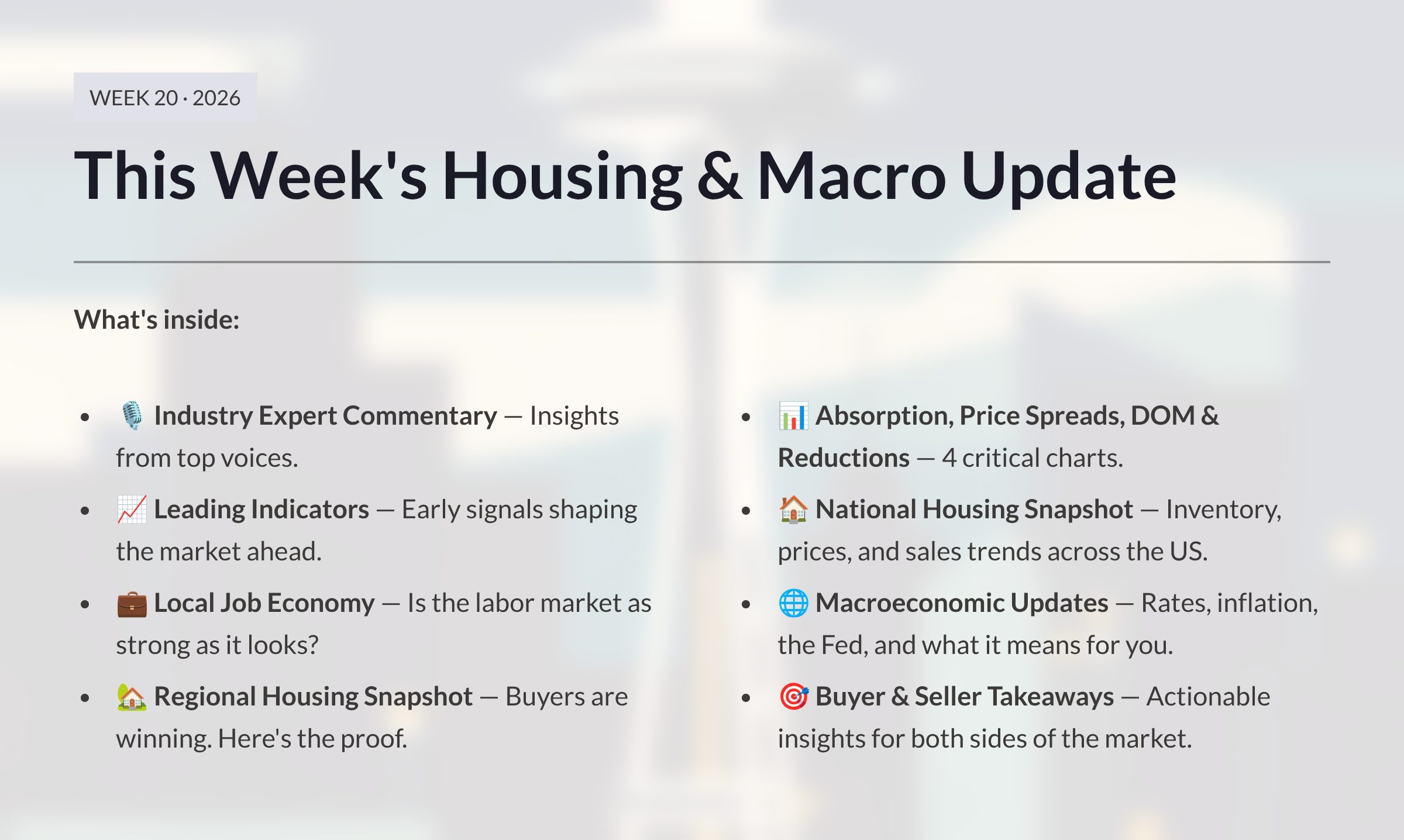
Intro: Understanding Last Week’s Real Estate Dynamics
The housing market across the greater Seattle–Tacoma–Everett region flashed a highly consistent signal last week. Data shows that buyers are steadily accumulating leverage, while sellers face an increasing need to align their pricing expectations with current market realities. Consequently, navigating this landscape requires separating optimistic listing metrics from real transaction values.
Macroeconomic data from the previous week continues to heavily influence our local environment. Sticky inflation forces a baseline narrative where interest rates remain firm, directly compressing overall household purchasing power. However, local transaction activity demonstrates that well-positioned properties are still moving, particularly within the region’s more accessible price bands.
What happened in the housing market across King, Pierce, and Snohomish counties last week, and why does it matter? Simply put, the market is functioning smoothly, but strict affordability limits are being enforced by buyers. This means unaligned listings are lingering on the market longer, making precise data tracking essential for real estate success.
Last Week’s Local Housing Data
The local housing metrics from the previous week reveal a distinct divergence based on price points and specific geographic sub-areas across the Puget Sound region.
-
Absorption Rates: The regional absorption rate eased slightly last week, landing at 43.22% compared to 43.93% the week before. While this represents a modest week-over-week softening of 1.59%, the absorption rate remains up 4.94% on a year-to-date basis. On the other hand, regional absorption dropped 14.42% compared to the same week last year, indicating that the overall velocity of sales is softer than the clip observed in 2025.
-
Widening Price Gaps: One of the most telling indicators of shifting market dynamics is the widening price gap between list prices and actual pending contract figures. Last week, the regional price gap grew to a substantial $130,000, reflecting a $915,000 median list price against a $785,000 median pending price. This gap has expanded significantly from the $85,000 spread tracked in early January.
-
Price Reductions: The share of homes undergoing price reductions ticked higher to 31.0% last week, up from 30.61% the previous week. This is notably higher than the price reduction rates of 27.95% in 2025 and 20.87% in 2024, confirming that negotiation is firmly back on the table.
-
Days on Market: Properties active on the market averaged 35 days on market, a metric that remained unchanged last week. In contrast, properties that successfully moved into pending status saw their median days on market drop to 21 days, down from 28 days the previous week. This highlights that appropriately priced homes are converting quickly, whereas overpriced inventory sits.
The geographic standouts across our three local counties further underscore this bifurcation. Sales velocity was strongest last week in accessible price points, led by Shoreline, Federal Way, Tacoma, and Maple Valley, with Seattle proper holding the fifth position. Conversely, premium Eastside markets faced the most prominent headwinds. Snoqualmie Pass sat at the bottom as the coldest local market, joined closely by Medina, Carnation, Kirkland, Bellevue, and Mercer Island, proving that the top price segments face the most significant resistance.
Last Week’s Macro and Jobs Backdrop
The broader macroeconomic environment heavily influences our local housing dynamics, characterized by a persistent tug-of-war between resilient economic growth and stubborn inflation data. Last week’s national macroeconomic data releases leaned into the bad-surprise column regarding price stability. Consumer price index (CPI) inflation accelerated to 3.8% year-over-year, and the producer price index (PPI) registered a sharp upside surprise at 6.0% year-over-year. As a direct consequence, the 30-year fixed mortgage rate ticked up 8 basis points last week to 6.65%, extending recent upward momentum and keeping affordability pressure elevated.
Meanwhile, the Federal Reserve left the benchmark funds rate unchanged at 3.50% to 3.75% at its last meeting. Bond markets priced in a 97% probability that the Fed will continue to hold rates steady at its upcoming June meeting, meaning a “higher-for-longer” interest rate environment remains the baseline scenario for the near term.
Despite national inflation pressures, the local labor market across King, Pierce, and Snohomish counties remains exceptionally tight, providing an underlying cushion for regional housing demand. Weekly initial unemployment claims came in at 1,286 for King County, 722 for Pierce County, and 517 for Snohomish County. These levels are between 80% and 83% below historical weekly medians, signaling that new layoffs are remarkably rare. Additionally, Washington State recorded zero new WARN notices for the week of May 11–17, meaning no large-scale corporate layoffs were formally announced. However, continued monthly unemployment claims are running 10% to 23% above historical medians across the three counties, indicating that workers who do lose their roles are taking longer to secure new employment.
What Last Week’s Numbers Suggest
For individuals keeping a close eye on the Puget Sound housing market, the previous week’s conditions imply that patience and precision are being rewarded. Because nearly a third of all regional listings have implemented price cuts and active homes are averaging 35 days on market, buyers do not need to rush. There is ample room to negotiate, perform thorough due diligence, and avoid the intense bidding wars of the past.
For owners preparing to list, success depends entirely on pricing a property to match current pending contract realities rather than outdated benchmarks or wishful thinking. The data shows that the lower-priced, entry-level segment is up about 16.05% in absorption this year, while the top premium segment has pulled back by roughly 10.69% year-to-date. Overpriced inventory is being penalized quickly by buyers who are fiercely protective of their monthly budgets. Working with real-time numbers is the only way to ensure your property converts instead of languishing.
Conclusion
The greater Seattle area housing market continues to demonstrate baseline stability, anchored by flat equity markets near record highs and a tight local labor market. Nevertheless, sticky inflation figures and a 6.65% mortgage rate mean that strict affordability limits are being enforced. This is a market that ultimately rewards careful preparation and data-driven strategy over guesswork.
If you’d like last week’s numbers broken down for your specific city and price range, reach out and I’ll send a personalized brief. If you’re thinking about making a move in the next 6–12 months, last week’s data is a good time to revisit your plan.


